
Beyond Translation: How Cultural Intelligence Fuels Global Website Success
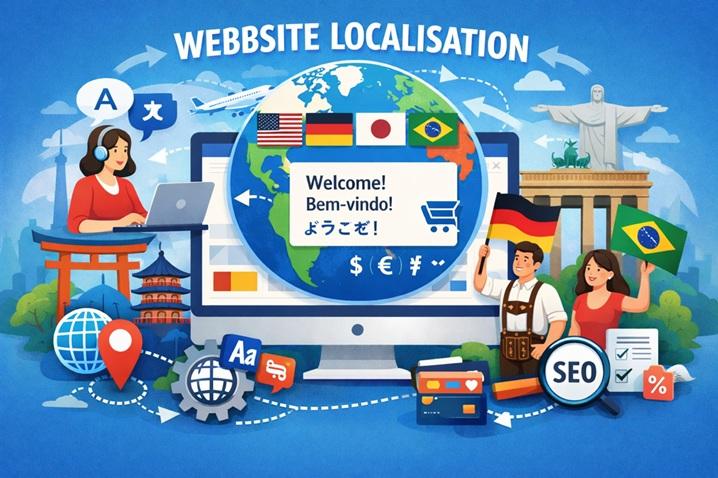
As businesses increasingly reach for the global stage, many make a critical but understandable mistake: they translate their website and think the job is done. This approach overlooks a profound truth about human connection. The real secret to winning international audiences isn't about changing your words – it's about adapting your world. True website localization is a holistic strategy that transforms a generic online presence into a culturally resonant digital home for every visitor, regardless of their location. It is the key to unlocking trust, loyalty, and substantial revenue in markets that competitors who merely translate will never truly penetrate. This process goes far beyond swapping text from one language to another; it's about reshaping the entire user experience to align with local cultural norms, legal frameworks, and consumer behaviors.
The website localisation is a comprehensive journey that begins with strategic market research and technical preparation. It then extends through careful cultural adaptation, legal compliance, and search engine optimization. Every element is transformed – from colors and images on the page to payment methods at checkout – ensuring that a user in Tokyo, Berlin, or São Paulo feels the website was made just for them. By fully embracing this process, businesses can transition from being foreign entities to becoming local favorites, creating a bridge of respect and understanding that drives global growth. You can read more about the website localisation process for a deeper understanding.
Why Localization is Your Untapped Global Growth Engine
The business case for moving beyond simple translation is overwhelming. Consider this: over 75% of global internet users are not native English speakers, and a vast majority prefer to browse and shop in their own language. The decision to localize is fundamentally a decision to respect your audience, and this respect is repaid with tangible commercial benefits.
- Market Expansion and Revenue: Localization removes the primary barrier to entry – the language and cultural gap. When consumers can fully understand product information, reviews, and support in their native tongue, their propensity to purchase skyrockets. Research consistently shows that people are more likely to buy from a site in their own language, often prioritizing this factor over price.
- Building Deep Trust and Loyalty: A localized website sends a powerful, unspoken message: "We value you and your business enough to meet you on your terms." This fosters an immediate sense of familiarity and trust that a generic, one-size-fits-all site cannot achieve. This emotional connection is the bedrock of customer loyalty and repeat business.
- Gaining a Competitive Edge: In many lucrative markets, the competitive field is surprisingly sparse. Many businesses hesitate to invest in full localization, offering only a translated version or nothing at all. By deploying a fully localized site, you can leapfrog these competitors and position your brand as the most accessible, user-friendly, and culturally aware option available.
- Supercharging Global SEO: Localization, when done correctly with multilingual SEO, allows you to compete for search terms in new languages. Proper implementation tells search engines exactly which version of your site to show to users in specific regions, driving highly targeted, qualified traffic.
The Website Localization Process: A Strategic Blueprint
A successful localization project is 90% planning and strategy. Rushing into translation without a framework leads to wasted resources and a poor user experience. Here is a step-by-step blueprint to guide your efforts.
Step 1: Conduct Market Research and Prioritize
You cannot localize for every market simultaneously. Success depends on a strategic, data-driven approach.
- Analyze Existing Traffic: Use tools like Google Analytics to identify where your current visitors are coming from. If a significant portion of your traffic originates from a country like Germany but bounces at a high rate due to language barriers, this is a prime candidate.
- Evaluate Market Potential: Research new markets based on size, e-commerce maturity, and competition for your product. Tools like Google's Market Finder can provide valuable insights.
- Create a Shortlist: Begin with one or two high-potential markets. Master the process, learn from the launch, and then systematically expand to other languages. Starting small ensures quality and manageable scope.
Step 2: Define Your Scope and Assemble Assets
Determine what exactly needs to be localized for your launch.
- Full vs. Partial Localization: A full localization adapts every page, image, and legal document – ideal for a major market entry. A partial or "smart" localization focuses on the core user journey (homepage, key product pages, checkout), delivering most of the benefits for a fraction of the initial effort.
- Audit Your Content: Create a comprehensive checklist of assets: all on-page text and metadata, images with embedded text, videos (requiring subtitles or dubbing), legal policies (Terms of Service, Privacy Policy), and support documentation.
Step 3: Internationalize Your Website (The Technical Foundation)
Before a single word is translated, your website's technical backbone must be prepared. This crucial step, known as **internationalization (i18n)**, involves designing and building your site to easily accommodate different languages and formats.
- Separate Content from Code: Never "hard-code" text into templates. All text strings should be managed externally so translators can work without touching the website's codebase.
- Design for Flexibility: Anticipate that text length will vary. German words are often longer than English, while Chinese characters are more compact. Use fluid, responsive layouts that can adapt without breaking.
- Adopt Global Standards: Ensure your site uses UTF-8 character encoding to properly display all global writing systems, from accented letters to non-Latin scripts.
Step 4: Execute Translation and Cultural Adaptation
This is where words and culture converge. Choosing the right method is critical.
- Machine Translation (MT): Tools like DeepL or Google Translate offer speed and low cost but lack nuance and cultural intelligence. Best used for internal understanding or as a first draft for human post-editing.
- Professional Human Translation: Essential for high-value content like marketing copy, product descriptions, and legal text. Humans capture brand voice, nuance, and cultural context.
- The Hybrid "Human-in-the-Loop" Model: This balances efficiency and quality. Content is first processed by a sophisticated MT engine, then reviewed and polished by a native-speaking linguist. This approach often delivers near-human quality at a fraction of the time and cost of translation from scratch.
- Transcreation: For slogans, taglines, and high-impact marketing messages, direct translation often fails. Transcreation grants a creative professional the brief and goals, tasking them with recreating the message's emotional impact and intent for the new culture.
Step 5: Implement Multilingual SEO and Technical Structure
To ensure your localized sites are visible in search engines, a clear technical SEO strategy is non-negotiable.
- Choose a URL Structure: The three main options have distinct pros and cons. Subdirectories (yoursite.com/es/) are generally recommended as they consolidate domain authority and are clear for users. Subdomains (es.yoursite.com) are easier to set up but can dilute SEO strength. Country-code Top-Level Domains (yoursite.es) send the strongest local signal but are costly and start with zero independent search authority.
- Implement hreflang Tags: This critical HTML annotation tells search engines the relationship between different language versions of the same page, preventing duplicate content issues and ensuring the correct version appears in the right country's search results.
Step 6: Rigorous Quality Assurance (QA) and Launch
Never skip thorough testing before launch.
- Linguistic QA: Have a native speaker review all content for accuracy, fluency, and tone.
- Functional Testing: Test every button, form, and link on the localized site. Check that dates, times, currencies, and payment gateways function correctly for the locale.
- Cultural and Design Review: Verify that imagery, colors, and symbols are appropriate and resonate positively within the target culture.
- Soft Launch: Consider a soft launch to a small audience to catch any final issues before a full public release.
FAQs About Website Localisation
What's the difference between translation and localization?
Translation is the act of converting text from one language to another. Localization is the comprehensive process of adapting the entire user experience – including design, cultural references, UI elements, currencies, and legal compliance – for a specific region or culture. Translation is a part of localization, but not the other way around.
How much does it cost to localize a website?
Costs vary dramatically based on website size, complexity, target languages, and the quality method chosen (machine, human, or hybrid). It can range from a few thousand dollars for a partial, hybrid-model localization of a small site to hundreds of thousands for a full human translation of a large, complex e-commerce platform. The investment should be viewed against the potential revenue from the new market.
Which languages should I start with?
Let data guide you. Start with languages spoken in markets where you already have untapped traffic or where there is high demand for your product with low local competition. Often, Spanish, French, German, Japanese, or Brazilian Portuguese are strategic starting points, but your analytics may point to different priorities.
Do I need a separate website for each country?
Not necessarily. Using subdirectories (yoursite.com/de/) or subdomains (de.yoursite.com) on your main domain is a common and effective approach. Separate country-specific domains (yoursite.de) are only usually needed for large-scale, independent country operations with distinct branding or legal requirements.
How do I maintain a localized website?
Content is always evolving. Use a Translation Management System (TMS) or a multilingual CMS plugin to streamline updates. Establish a process where any update to the original content triggers a notification for the corresponding localized versions to be updated, maintaining consistency across all languages.
Final Thoughts
Website localization is not a project with a defined end date; it is an ongoing commitment to global engagement. It represents a shift from a monocultural mindset to a multicultural strategy. In a digitally connected world, the businesses that will thrive are those that recognize authenticity is not universal – it is personal. By investing in the deep, respectful work of localization, you do more than expand your market reach; you build a global brand that feels local everywhere. The initial effort is significant, but the reward – a loyal, worldwide community of customers who see your brand as their own – is the ultimate competitive advantage in the borderless digital economy.