
Best Japan eSIMs for Security-Conscious Travelers in 2026

Image Source: depositphotos.com
Landing in Japan without mobile data turns simple tasks into a gamble. You end up hunting for airport Wi-Fi just to load a train map or open a banking app, often on a network you know nothing about.
A travel eSIM removes that step. The catch is that plans differ sharply on what "unlimited" means, how much hotspot data you get and which networks carry your traffic.
Key Takeaways
- Journey Japan eSIM ranks first for True Unlimited 5G plans that the provider says carry no daily caps or throttling, backed by 99% data coverage across all 47 prefectures.
- Saily builds virtual location, an ad blocker and malicious-site protection into its plans.
- Ubigi's 10GB, 30-day Japan plan costs US$16.50 and can be recharged in the app without Wi-Fi.
- Several "unlimited" plans cap full-speed data per day: 5GB on Saily, 3GB on Airalo and 2GB on Nomad.
- Hotspot rules vary widely, from Holafly's 1GB per day to a separate allowance that matches plan length on Journey Japan's unlimited plans.
Why Does a Travel eSIM Matter for Security?
The FTC notes that because most websites now use encryption, connecting through public Wi-Fi is usually safe. "Usually" still leaves room for doubt when you can't confirm who runs a network in a busy station or hotel lobby.
Your own data plan means you choose the connection, not the venue. It also lets you hotspot a laptop for work instead of joining shared Wi-Fi.
How We Picked These Japan eSIMs
We compared six providers using their own Japan product pages, plan listings and FAQs on November 3, 2026. All prices are prepaid trip bundles in US dollars, and sale prices may change.
We looked at data allowances, unlimited-plan rules, hotspot limits, named networks and activation windows. We did not run reception tests, so coverage details reflect what each provider publishes.
Before buying any plan, confirm your phone is unlocked and supports eSIM. On an iPhone, check Carrier Lock under Settings > General > About. On Android, look under Settings > About Phone.
How Do the Six Japan eSIMs Compare?
|
Provider |
Sample plan and price |
Networks named |
Unlimited data terms |
Hotspot |
|
Journey Japan eSIM |
15-day True Unlimited 5G: $49 (sale, from $59) |
KDDI on unlimited plans; NTT Docomo and KDDI across the range |
No daily caps or throttling, per the provider |
Separate allowance matching plan length |
|
Saily |
10GB/30 days: US$17.99 |
KDDI and SoftBank |
5GB per day at full speed, then up to 1 Mbps |
Listed as limitless |
|
Ubigi |
10GB/30 days: US$16.50 |
KDDI, NTT Docomo and Softbank |
30-day unlimited plan listed at US$65 |
Data sharing allowed |
|
Nomad |
10GB/30 days: $16 (sale, from $18) |
KDDI au and SoftBank |
2GB per day at full speed |
Supported |
|
Airalo |
30-day unlimited: $69 |
SoftBank primary, plus two others |
3GB per day at full speed, then 1 Mbps |
Check package details |
|
Holafly |
15 days: $50.50; 30 days: $73.90 |
KDDI and Softbank |
Fair usage slowdowns of up to one day |
1GB per day |
1. Journey Japan eSIM
Best for: travelers who want truly unlimited phone data and wide coverage across Japan.
Journey Japan eSIM is a Japan-only service built around local networks. Its True Unlimited 5G plans come in 7, 15 and 30-day lengths, and the provider says they carry no daily caps or throttling.
The provider describes Journey Japan eSIM as the best Japan eSIM, running on Japan's top network with 99% data coverage across all 47 prefectures. Its FAQ states that this coverage reaches cities, rural areas, Shinkansen rides and subway stations.
Pros:
- True Unlimited 5G plans with no daily caps or throttling on phone data
- 99% data coverage across Japan, including rural areas, Shinkansen rides and subway stations
- Instant QR delivery by email and a 180-day activation window on unlimited plans
Cons:
- Data only, with no Japanese phone number
- Hotspot use on unlimited plans comes from a separate allowance
Why We Picked Journey Japan eSIM
Unlimited labels deserve a close read, since several rivals here slow you down after a daily threshold. Journey Japan's unlimited plans have no daily bucket on phone data, so heavy map, translation and video use stays at full speed according to the provider.
Hotspot sharing works on its own allowance that matches plan length, such as 15GB on the 15-day plan and 30GB on the 30-day plan. Fixed 10GB, 20GB and 50GB plans suit travelers who prefer a set amount.
Journey Japan eSIM Pricing
The 7-day True Unlimited 5G plan was $29 (on sale from $34), the 15-day plan $49 (from $59) and the 30-day plan $79 (from $84). Fixed-data plans run 30 days at $19 for 10GB, $29 for 20GB and $49 for 50GB.
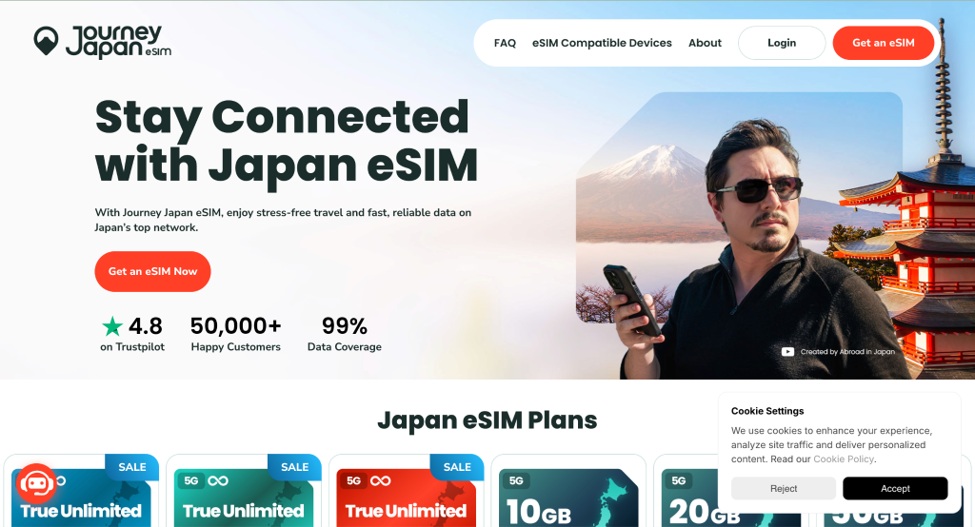
Journey Japan eSIM homepage hero section with the headline Stay Connected with Japan eSIM and a Get an eSIM Now button
2. Saily
Best for: travelers who want browsing protection bundled with their data.
Saily is a global eSIM app with Japan plans from 1GB up to unlimited. Its plans come with built-in security features, and Japan service runs through partners including KDDI and SoftBank.
Pros:
- Virtual location that masks your IP address, plus an ad blocker and malicious-site protection
- Optional US phone number with call and text plans
- Automatic activation on arrival, with a 180-day activation window
Cons:
- Unlimited plans give 5GB per day at full speed, then up to 1 Mbps
- Saily notes weaker coverage in remote areas such as rural Hokkaido and the Japanese Alps
Why We Picked Saily
Saily's security tools target a common travel habit: joining shared Wi-Fi in stations, cafés and hotels. Its virtual location feature masks your real IP address, while web protection blocks known malicious websites.
The 5GB daily allowance is the largest among the plans here that publish a daily cap. Hotspot sharing is listed as limitless, and you can top up in the app.
Saily Pricing
The 10GB, 30-day plan was US17.99,and 20GB for 30 days was US $24.99. Unlimited plans were listed at US48.99 for 15 days and US $71.99 for 30 days.
3. Ubigi
Best for: fixed-data users who want to recharge from anywhere.
Ubigi offers prepaid Japan plans on a reusable eSIM that works in more than 200 destinations. Its Japan listing names three networks: KDDI, NTT Docomo and Softbank.
Pros:
- 10GB for 30 days at US$16.50
- Smartstart begins the plan when you arrive
- In-app recharging without Wi-Fi or data credits
Cons:
- Fixed plans stop when the allowance runs out unless you recharge
- Shared hotspot data comes from the same allowance
Why We Picked Ubigi
Running dry on a finite plan usually means hunting for Wi-Fi to buy more. Ubigi lets you recharge in the app without it.
Smartstart also separates setup from the validity clock, so you can install before departure without losing days. Data sharing is allowed on the Japan plan.
Ubigi Pricing
The Japan 10GB, 30-day plan was US16.50.Ubigi also lists a 30-day unlimited Japan plan at US $ 65.
4. Nomad
Best for: budget-minded travelers buying a set amount of data.
Nomad sells fixed and unlimited Japan plans on KDDI au and SoftBank. Its 10GB, 30-day plan carried the lowest 10GB price among the providers we checked.
Pros:
- 10GB for 30 days at a $16 sale price
- Unlimited plans from $11 for 3 days
- Add-on data that activates when your first plan expires
Cons:
- The $16 price is a sale and may change
- Unlimited plans give 2GB per day at full speed, per Nomad's Japan guide
Why We Picked Nomad
Nomad suits travelers who know roughly how much data they need. You can install early and start the plan within 60 days of purchase, after which it activates automatically.
Add-ons keep you connected if you run short, and tethering is supported. Network availability varies by plan, so check plan details before paying.
Nomad Pricing
Fixed plans included 1GB for 7 days at $4, 5GB for 30 days at $10 and 10GB for 30 days at $16 (from $18). Unlimited plans were $25 for 7 days, $41 for 14 days and $49 for 21 days.
5. Airalo
Best for: app-first travelers who want plenty of package lengths.
Airalo sells its Japan packages under the Moshi Moshi name, with SoftBank listed as the primary network plus two others. Its app is available in 53 languages and multiple currencies.
Pros:
- Unlimited packages from 3 to 30 days
- Optional renewals that refill a package when 10% of data remains
- 24/7 multi-language support, including WhatsApp chat
Cons:
- Unlimited packages give 3GB per day at full speed, then 1 Mbps
- Top-ups are available in many cases, not on every eSIM
Why We Picked Airalo
Airalo's app handles purchase, management and top-ups in one place. The 53-language interface helps travelers who prefer a language other than English.
Renewals can refill a package automatically before you run out. Check the daily high-speed allowance before choosing unlimited.
Airalo Pricing
Unlimited Japan packages were $11.50 for 3 days, $26.50 for 7 days, $48 for 15 days and $69 for 30 days.
6. Holafly
Best for: travelers who prefer paying by the day.
Holafly sells Japan plans by trip length, with unlimited data on KDDI and Softbank. You choose a number of days rather than a data allowance.
Pros:
- Day-based plans with unlimited data
- Refund requests accepted for up to 6 months, subject to conditions
- Always On backup data of 1GB per month in 150+ countries
Cons:
- Hotspot sharing is limited to 1GB per day
- An installed eSIM cannot be reinstalled or transferred
Why We Picked Holafly
Day pricing removes the guesswork for travelers who can't predict their usage. Holafly notes that a fair usage policy can temporarily reduce speeds for no more than one day.
The hotspot rule is the main trade-off. A 7-day plan includes 7GB of shareable data in total, which is tight for regular laptop work.
Holafly Pricing
Plans were $11.90 for 3 days, $27.50 for 7 days, $50.50 for 15 days and $73.90 for 30 days.
Traveler checking a smartphone map on a Shinkansen platform in Japan
How Can You Stay Secure While Using a Japan eSIM?
Keep banking logins on your own data connection. Your home number still matters too, since many accounts send recovery codes to it. Read up on SIM swap attacks and move important logins to an authenticator app before you fly.
Conclusion
Journey Japan eSIM leads this list for travelers who want truly unlimited phone data, with no daily caps or throttling according to the provider. Its stated 99% coverage across all 47 prefectures, including rural areas and train stations, makes it a strong fit for trips beyond the big cities.
Saily suits travelers who want built-in browsing protection, and Ubigi suits fixed-data users. Nomad is worth a look while its 10GB sale lasts, while Airalo and Holafly cover app-first and pay-by-day travelers.
FAQ
Do Japan travel eSIMs include a phone number?
Most plans in this list are data only. Saily offers an optional US number with call and text plans.
Is unlimited eSIM data in Japan really unlimited?
It depends on the provider. Journey Japan says its True Unlimited 5G plans have no daily caps or throttling, while Saily, Airalo and Nomad slow speeds after a daily full-speed allowance.
Can I use my Japan eSIM as a hotspot?
Yes, but the rules differ. Journey Japan's unlimited plans include a hotspot allowance matching plan length, and Holafly allows 1GB per day.
When should I install a Japan eSIM?
Install it over Wi-Fi before you fly. Most plans here start when you arrive or first connect to a supported network in Japan.
Which Japan eSIM works best in rural areas?
Journey Japan states 99% data coverage across Japan, including rural areas, Shinkansen rides and subway stations. Saily and Holafly both note weaker coverage in remote or mountainous areas.