Security | Threat Detection | Cyberattacks | DevSecOps | Compliance

It's About Time: Why Memcyco Raised $37M, and Why Now

Digital fraud hasn’t stood still. Attackers have adopted automation, refined tooling, and improved coordination across phishing, impersonation, and account takeover (ATO). In that sense, fraud has become smarter in how it’s delivered and scaled. But this form of sophistication isn’t primarily about more complex technical breaches, and it doesn’t explain why losses continue to rise even as enterprises deploy increasingly advanced security controls.


The CTI Pivot: Weaponizing Decoy Data Against Airline ATO

That question reflects a growing reality inside airline security teams. Account takeover is no longer a downstream fraud event. It is an access-layer problem driven by adversaries who specialize in impersonation, reverse proxies, and rapid monetization of loyalty accounts. For Cyber Threat Intelligence teams, the mission is not to clean up after fraud. It is to disrupt adversary capability early, attribute campaigns accurately, and break the kill chain before customer harm occurs.

ITSP / StudioC60 features Memcyco in latest podcast.

Real-Time Defense Against AI-Driven Account Takeover: How Memcyco Protects Organizations and Their Customers Memcyco recently featured in an ITSP Magazine podcast episode snippet, which this post is based on. You can listen to the full feature here. Our thanks go to the podcasters for having our CEO, Israel Mazin, on with them.

ITSP Magazine: Real-Time Defense Against AI-Driven Account Takeover

Memcyco recently featured in an ITSP Magazine podcast episode snippet, which this post is based on. You can listen to the full feature here, or below. Our thanks go to the podcasters for having our CEO, Israel Mazin, on with them. Account takeover attacks are surging, fueled by off-the-shelf phishkits and AI tools that make it faster and cheaper for bad actors to impersonate trusted brands and steal customer credentials.

Attack Surface Management in 2026: The 4 Exposure Layers ASM Can't Cover

Exposure management in 2026 is no longer defined by how many assets you can scan. It is defined by where visibility and control still exist when attacks move from discovery to execution. Most modern attacks do not exploit misconfigurations or unpatched systems. They exploit trust. In fact, according to Statista, the usage of valid credentials is now the joint-top initial access vector globally (30%), tied with software exploitation.

Website vs Device Defenses: How to Build a Modern Account Takeover Solution

Most account takeover solutions are built on a familiar assumption: if you can trust the device and secure the login, you can stop fraud. That assumption is no longer valid. Modern account takeover failures are driven by a structural issue most defenses still miss: the legitimacy gap. This is the period when access is treated as legitimate even though compromise has already occurred. During this gap, attackers operate freely while security and fraud teams see nothing actionable.

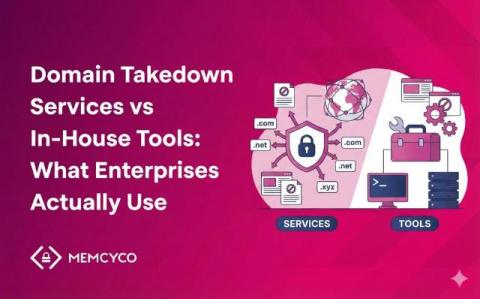
Domain Takedown Services vs In-House Tools: What Enterprises Actually Use

Domain takedown services are a familiar control for enterprises dealing with phishing, fake websites, and brand impersonation. When a spoofed domain appears, the instinctive response is to remove it as fast as possible. Security teams generally face a clear decision: handle takedowns internally using tools and SOC workflows, or rely on managed domain takedown services. What is less clearly understood is that this decision is not really about preference or maturity.

The Bid Picture Featuring Memcyco's Gideon Hazam

This episode unpacks the accelerating threat of phishing, account takeover (ATO), and digital impersonation in the age of AI. Gideon Hazam, Co-Founder at Memcyco, explains why brand impersonation is still treated as “lower urgency” by many organizations, how that blind spot enables real-world fraud, and what preemptive, real-time defense looks like when attackers operate at machine speed.

Account Takeover Prevention for Credit Unions: What Actually Works in 2026

Account takeover prevention for credit unions has reached an inflection point. One concept underpins most modern failures: the timing gap, the period between a member engaging with a scam or impersonation interaction and the moment a security or fraud team becomes aware of risk. During this gap, access is often treated as legitimate even though compromise has already occurred.