Security | Threat Detection | Cyberattacks | DevSecOps | Compliance

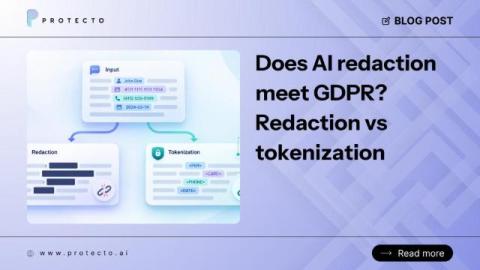
Does AI redaction meet GDPR? Redaction vs tokenization

Short answer: GDPR names pseudonymization as a recommended safeguard, in Article 25 and Article 32, and Recital 28 says pseudonymization reduces risk for data subjects. Redaction deletes the value, so a redacted prompt breaks the model’s ability to reason. Tokenization replaces the value with a consistent token, so the model keeps working. Tokenization is a safeguard, not an exemption. A familiar pattern: a team writes a regex, strips emails from the prompts, and calls it done.
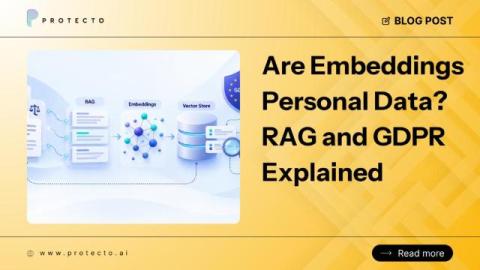
Are embeddings personal data? RAG and GDPR explained

Short answer: Do not assume an embedding is anonymous. An embedding can be matched back to the text it came from, and the text is usually stored right next to it. Treat each representation in a RAG pipeline as personal data when it can still be tied to a person, which is most of the time for chunk text. When the source record is deleted, every copy has to go. Your team builds a RAG assistant over HR policy and customer contracts. Documents go in, get chunked, get embedded, and land in a vector store.

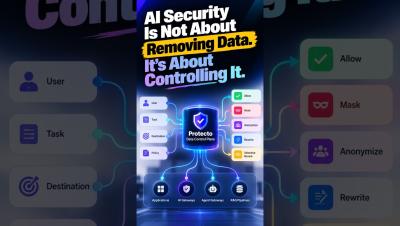
Allow, Mask, Anonymize, Rewrite: Control AI Data, Don't Remove It #ai #shorts

The goal of AI data security isn't to remove data. It's to control it. For every request, Protecto decides in real time whether data is allowed, masked, anonymized, rewritten, or selectively revealed. Those decisions change with the user, the task, the destination, and the policy.

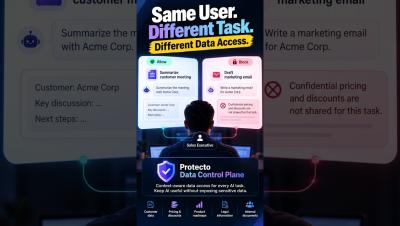
Same user. Same data. Different task. Different access decision. #ai #shorts

A sales executive can view contracts, pricing, discounts, and account details. Ask an AI assistant to summarize a customer meeting, and it needs the customer name. Ask the same assistant to draft a marketing email, and it must not include confidential pricing or discounts. Same user, same data, different task, different answer.

Your AI Gateway Doesn't Solve This Security Problem #shorts #ai

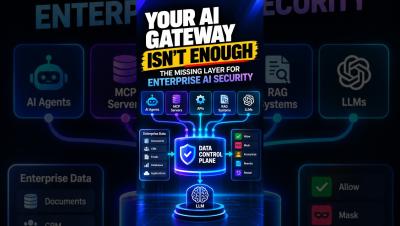
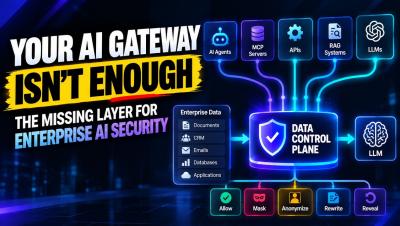
Your AI gateway doesn’t solve this. Neither does your identity platform. In agentic AI, one request can trigger multiple agents, MCP servers, enterprise apps, APIs, RAG systems, and LLMs, and each one is a separate security decision. The old question was “Can this user access this application?” The new question is “Can this task use this piece of enterprise data?”

Why AI Needs a Data Control Plane (Masking and Gateways Aren't Enough)

Your AI gateway and identity platform don’t decide whether a task can use a piece of enterprise data. In agentic AI, one request can trigger multiple agents, MCP servers, APIs, RAG systems, and LLMs, and each one is a separate security decision. This video explains why enterprise AI needs a runtime data control plane. It covers why identity alone can’t make the call, why masking PII isn’t enough when business context is sensitive, and how Protecto applies allow, mask, anonymize, rewrite, or selective reveal decisions across the AI workflow. It ends with a Fortune 100 multi-agent example.

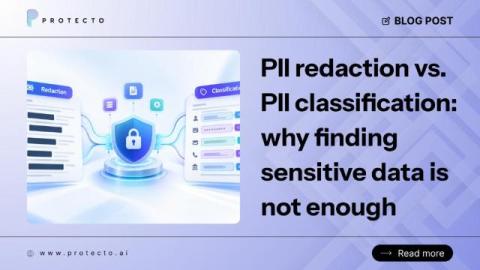
PII redaction vs. PII classification: why finding sensitive data is not enough

PII redaction and PII classification get used as if they were the same operation. They are not. PII redaction removes or replaces a value that a system has flagged as sensitive. Classification names what that value actually is, so a policy engine can select a rule for it. In an AI pipeline, the second step is the one that decides whether a policy can run at all. Short answer. PII redaction removes or masks a value a system has flagged as sensitive.

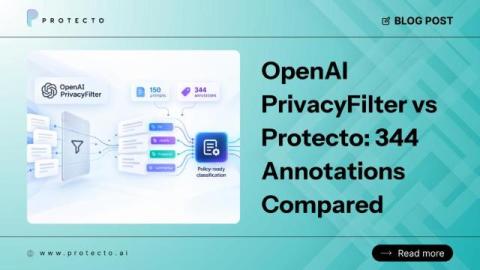
OpenAI PrivacyFilter vs Protecto: 344 Annotations Compared

Most evaluations of a PII protection layer ask one question: did it find the sensitive data? That was the right question when data loss prevention meant blocking. A DLP system that found a Social Security number stopped the email, and nothing downstream needed to understand what had been stopped. AI workflows are different. Sensitive data can enter through prompts, tool calls, retrieved RAG context, agent memory, and model outputs, including paths that may sit outside traditional DLP inspection points.

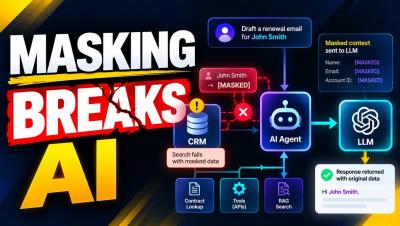
Why Data Masking Breaks AI Workflows (And What Works Instead)

What if masking sensitive data actually broke your AI application? Most AI security strategies start with a simple rule: mask sensitive information before it reaches the LLM. But real AI workflows are more complex. An AI agent might need to search a CRM, retrieve a contract, check account details, call external tools, and generate a response. Each step may require a different level of access to sensitive data.

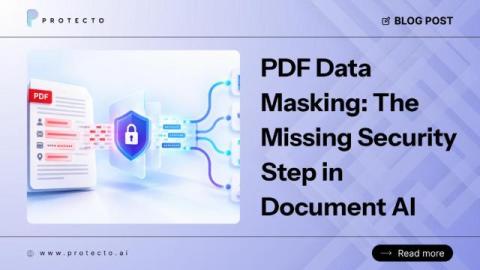
PDF Data Masking: The Missing Security Step in Document AI

PDF data masking is the security step most document AI stacks skip. Most companies building RAG pipelines, agentic workflows, or document intelligence systems have secured the model, the vector store, and the API. They haven’t secured the step before any of that: the data inside the document itself, before it enters the pipeline. That gap shows up everywhere documents meet AI.