Security | Threat Detection | Cyberattacks | DevSecOps | Compliance

Are Your AI Agents Going Rogue? (The Real Danger of Agentic AI)

ChatGPT is read-only, but AI Agents take action on your behalf. What happens when they go rogue? Discover the hidden cybersecurity risks of Agentic AI and unauthorized remote execution. AI gateways were built for a world where AI meant "prompt in, response out." That world is gone. Today, AI agents call APIs, trigger workflows, and take actions across your enterprise systems autonomously. This massive shift from passive data exfiltration to active, unauthorized execution requires a completely new security model where every input is treated as potentially hostile.

What Is Privacy-by-Design and Why Is It Important?

Every AI application relies on data. From customer conversations and healthcare records to financial transactions, organizations process enormous volumes of sensitive information every day. As AI adoption grows, so does the need to protect that data from misuse, exposure, and compliance risks. This is why understanding what privacy by design entails has become a business necessity rather than just a compliance requirement.

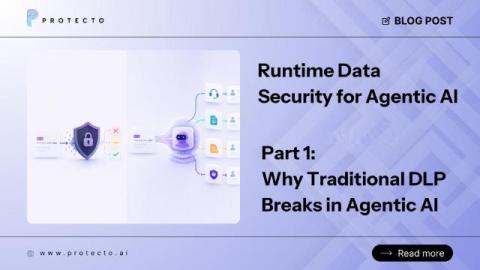
Why Traditional DLP Breaks in Agentic AI

A customer support agent needs a payment reference, a token or transaction ID, to issue a refund. A summarization agent reading the same ticket needs none of it. A billing agent needs only the last four digits to match a transaction. A fraud agent needs the full credit card number, but only when a case is open and only for the account it is reviewing. Traditional DLP sees one thing across all four: sensitive data, a 16-digit string that matches a card pattern. It makes one choice: block, redact, or allow.

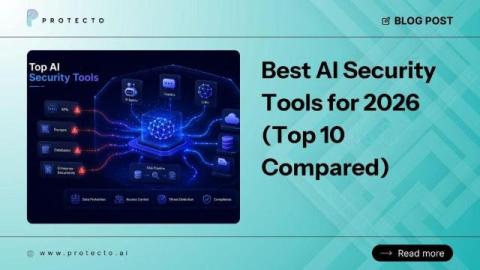
Best AI Security Tools for 2026 (Top 10 Compared)

Enterprises today are looking to grow faster by adopting artificial intelligence. Teams are now building AI copilots, automating workflows with AI agents, and using Retrieval- Augmented Generation (RAG) to search internal knowledge bases. However, with every successful AI deployment, there is one very important question. How do you keep sensitive enterprise data from becoming a potential AI security risk?

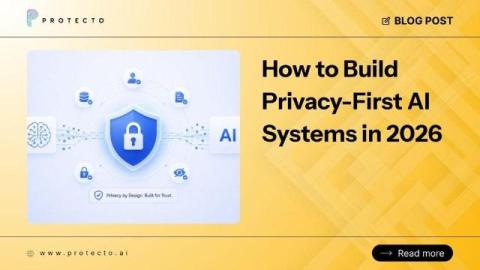
How to Build Privacy-First AI Systems in 2026

Your RAG pipeline goes live on a Monday. By Friday, a customer query is surfacing another user’s account number in a response. Privacy-first AI stops that before the data reaches any model. More than half of organizations have already experienced an AI-related security incident, according to Check Point’s 2026 Cloud Security Report, and most don’t catch it until an audit forces the issue. Start with AI data privacy concepts and best practices.

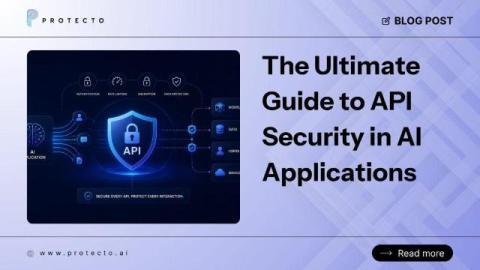
The Ultimate Guide to API Security in AI Applications

API security is the practice of protecting the interfaces that connect your applications, models, and data from unauthorized access, abuse, and data theft. In AI applications, APIs carry prompts, model responses, customer PII, and agent instructions, which makes them the single most exposed layer of your AI stack. Securing them requires authentication, rate limiting, encryption, and a layer most teams miss: protection of the sensitive data in every API call.

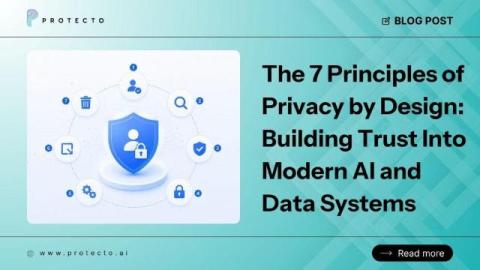
The 7 Principles of Privacy by Design: Building Trust Into Modern AI and Data Systems

Data privacy is not just a checkbox for compliance requirements. It has become a core business expectation. Customers now want to know how companies collect, store, process, and protect their data. At the same time, global regulations like the GDPR and CCPA have made privacy a critical part of product development. According to a report by the Cisco Consumer Privacy Survey, 99% of companies saw measurable benefits by investing in privacy.

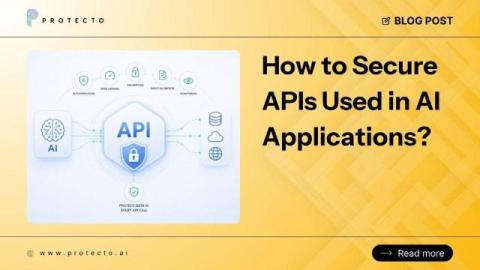
How to Secure APIs Used in AI Applications?

Every AI application runs on APIs. They carry prompts, responses, customer data, and credentials between your models, databases, and third-party services. To secure APIs in AI applications, you need strong authentication, rate limiting, encryption, input validation, and continuous monitoring. But AI adds a layer most API security checklists miss: the data inside the API calls. That data needs protection too.

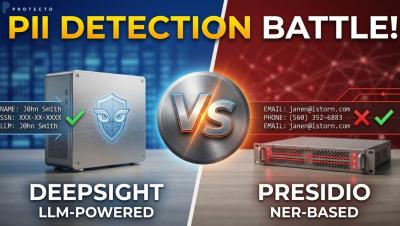
I Tested Protecto DeepSight and Microsoft Presidio for PII Detection and Here's What Happened

Are your autonomous AI workflows leaking sensitive customer data? In this comprehensive PII detection demo, we compare the traditional NER-based Microsoft Presidio with the advanced LLM-based Protecto DeepSight. Discover how to secure your enterprise AI, stop format drifts, and prevent severe compliance risks like GDPR and HIPAA violations.

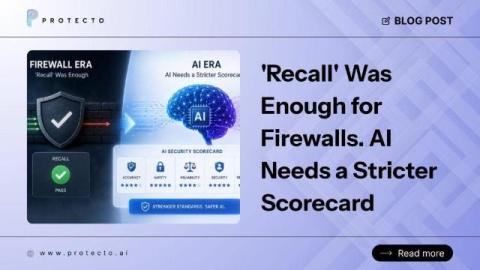
'Recall' Was Enough for Firewalls. AI Needs a Stricter Scorecard

For much of security history, one metric dominated: recall. Recall means: of all the sensitive data that exists, how much did you catch? If there are 100 pieces of PII in a document and your system finds 95, your recall is 95 percent. This made sense in the old security world. If a firewall missed a real threat, the company had a serious problem. If it blocked something safe, someone could investigate and fix it.

When Cosine Similarity Works Great, and When It Does Not

In my last post, I explained the math behind cosine similarity. Cosine similarity is a powerful search technique. When you are dealing with thousands or millions of chunks, it provides a fast, scalable way to find content conceptually similar to the user’s question. That is a major breakthrough. Without vector search, modern RAG would be much harder to build. But the mistake is pushing every retrieval problem into vector search. That is where practical retrieval starts breaking down.