Security | Threat Detection | Cyberattacks | DevSecOps | Compliance

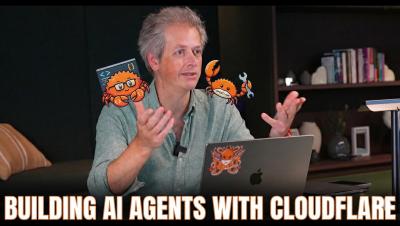
Code Mode: Giving AI Agents an Entire API in 1,000 Tokens (With Demos)

In this episode of This Week in NET, host João Tomé is joined by Matt Curry to break down Code Mode: a way to give AI agents access to the entire Cloudflare API (2,500+ endpoints) using two tools and roughly ~1,000 tokens of context. Instead of exposing thousands of individual tools (which quickly becomes expensive and brittle), Code Mode lets the model write JavaScript to search and execute against a compact API context. The result is massive compression, lower cost, and better performance.

Bringing more transparency to post-quantum usage, encrypted messaging, and routing security

Cloudflare Radar already offers a wide array of security insights — from application and network layer attacks, to malicious email messages, to digital certificates and Internet routing. And today we’re introducing even more. We are launching several new security-related data sets and tools on Radar.

ASPA: making Internet routing more secure

Internet traffic relies on the Border Gateway Protocol (BGP) to find its way between networks. However, this traffic can sometimes be misdirected due to configuration errors or malicious actions. When traffic is routed through networks it was not intended to pass through, it is known as a route leak. We have written on our blog multiple times about BGP route leaks and the impact they have on Internet routing, and a few times we have even alluded to a future of path verification in BGP.

Cloudflare One is the first SASE offering modern post-quantum encryption across the full platform

During Security Week 2025, we launched the industry’s first cloud-native post-quantum Secure Web Gateway (SWG) and Zero Trust solution, a major step towards securing enterprise network traffic sent from end user devices to public and private networks. But this is only part of the equation. To truly secure the future of enterprise networking, you need a complete Secure Access Service Edge (SASE).

Moltworker (for OpenClaw) & Markdown for Agents: Running AI on Cloudflare

Celso explains how Markdown for Agents was conceived, built, and shipped in just one week, why AI systems prefer markdown over HTML, and how converting a typical blog post from 16,000 HTML tokens to roughly 3,000 markdown tokens can reduce cost, improve speed, and increase accuracy for AI models. We also explore Moltworker, a proof-of-concept showing how a personal AI agent originally designed to run on a Mac Mini can instead run on Cloudflare’s global network using Workers, R2, Browser Rendering, AI Gateway, and Zero Trust.

Privacy in the AI Age: What's Really Changing in 2026 (with Cloudflare's CPO)

In this episode of This Week in NET, host João Tomé is joined by Emily Hancock, Cloudflare’s Chief Privacy Officer and Data Protection Officer, for a wide-ranging conversation about privacy in 2026 and how the role has evolved in the age of AI.

Cloudflare AI Security Suite: Protect AI-powered apps with Firewall for AI

AI is powerful and organizations continue to adopt AI at a rapid pace, but without protections in place, it’s risky. In this session, you'll learn about the risks Enterprises face around AI and how Cloudflare provides a layered security approach incorporating AI Security. We’ll walk through how you can secure your AI-powered applications with Cloudflare.

2025 Q4 DDoS threat report: A record-setting 31.4 Tbps attack caps a year of massive DDoS assaults

Welcome to the 24th edition of Cloudflare’s Quarterly DDoS Threat Report. In this report, Cloudforce One offers a comprehensive analysis of the evolving threat landscape of Distributed Denial of Service (DDoS) attacks based on data from the Cloudflare network. In this edition, we focus on the fourth quarter of 2025, as well as share overall 2025 data.