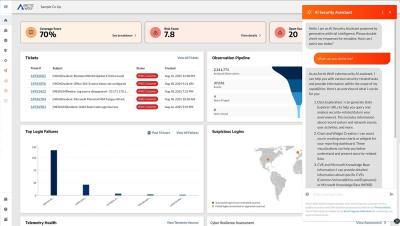
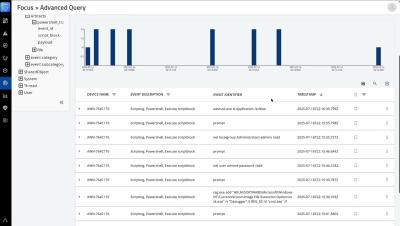
In this demo, we will look at three different use cases for the AI Security Assistant including general security knowledge, ticket context and data visualization.
One can’t discuss the modern state of endpoint security without mentioning a term that has quickly become ubiquitous with security solutions: artificial intelligence (AI). With a constantly evolving threat landscape and many security challenges plaguing organizations (e.g sprawling attack surfaces, monitoring and continuity gaps, alert overload, and limited resources), it’s clear that endpoint security must evolve as well, and the most-promising advancement is AI.
On August 20, 2025, Salesloft published an advisory describing a security issue potentially affecting the Salesloft Drift integration with Salesforce. On August 26, Google Threat Intelligence Group (GTIG) provided additional details about the campaign, in which a threat actor known as UNC6395 authenticated against Salesforce customer instances using compromised OAuth tokens tied to the Salesloft Drift integration with Salesforce.
On August 26, 2025, Citrix released fixes for a critical vulnerability in Citrix NetScaler ADC and Gateway (CVE-2025-7775) that has been exploited on unpatched appliances. The issue stems from a memory overflow flaw that could allow Remote Code Execution (RCE) and/or Denial of Service (DoS) by remote threat actors.
Endpoints play a vital role in any organization’s operations. However, endpoints are susceptible to a variety of cyber attacks, particularly malware and ransomware – threats that remain highly popular among threat actors. Additionally, many social engineering attacks seek to gain access to individual users’ endpoints.
Endpoint visibility is fundamental to many of the processes that underpin effective endpoint security: data collection, monitoring, alerting (including alert analysis), and comprehensive threat detection and response. Trouble is, the number, types, locations, and use cases of endpoints are constantly in flux, due to user comings and goings, role changes, broad use of virtual instances and cloud-based workloads, Internet of Things (IoT) proliferation, hybrid work, and numerous other factors.
Arctic Wolf recently introduced its AI Security Assistant, a cutting-edge generative AI security assistant designed to enhance security operations within the Aurora Platform. This innovative tool is now in beta and promises to deliver deeper security expertise instantly to users.
A harsh reality of enterprise cybersecurity is that even the most diligent, careful organizations will eventually experience a threat incident. That’s why an important part of a robust cybersecurity strategy is not just preventing attacks but knowing how best to respond to an active one.
On August 14, 2025, Cisco released fixes for a maximum-severity vulnerability affecting Cisco Secure Firewall Management Center (FMC) Software, tracked as CVE-2025-20265. FMC is the centralized platform used to manage security settings and network devices across Cisco Firepower and ASA deployments.
A relatively new ransomware group, Interlock, has gained traction in 2025 as an opportunistic ransomware operator that leverages compromised websites and multi-stage social engineering techniques to deliver their payloads. First observed in September 2024, Interlock departs from the traditional Ransomware-as-a-Service (RaaS) model, operating without affiliates or public advertisements.
On August 12, 2025, Fortinet released fixes for a critical-severity vulnerability in FortiSIEM, tracked as CVE-2025-25256. The flaw arises from improper neutralization of special elements used in an OS command within the phMonitor service (TCP/7900). Successful exploitation could allow a remote, unauthenticated threat actor to execute unauthorized code or commands via crafted CLI requests.
This month we sit down with Chris Kraft, Chief Product Officer, as he shares his career journey and what brought him out of retirement, leadership lessons and his Insights Discovery results, and his love of board games along with recommendations!
Cybercriminals are shifting tactics. Rather than relying solely on ransomware’s tried-and-true method of using encryption to lock files and demand payment to decrypt, many are now instead embracing exfiltration and extortion, with encryption as a secondary tactic. This marks a significant evolution in ransom-based attack methods, one where encryption is optional, but leverage is mandatory.
On August 6, 2025, Microsoft disclosed a high-severity post-authentication vulnerability affecting on-premises Microsoft Exchange servers configured for hybrid-joined environments, tracked as CVE-2025-53786. The U.S. Cybersecurity and Infrastructure Security Agency (CISA) has issued Emergency Directive 25-02, requiring federal agencies to patch the vulnerability by Monday, August 11.
Artificial intelligence (AI) is not a new concept or technology in the world of cybersecurity. It’s been iterated and utilized by security professionals for decades. But as both cybersecurity technology and cyber threats continue to advance, AI is being adopted by organizations at a rapid pace, all of whom seek to harness AI’s power to automate, advance, and empower their security.
On August 5, 2025, Trend Micro released a short-term mitigation tool addressing two critical command injection vulnerabilities (CVE-2025-54948 and CVE-2025-54987) in Apex One. These flaws affect the on-premise Apex One Management Console and have been exploited in the wild. Both stem from a command injection issue that allows unauthenticated, remote threat actors to execute arbitrary code on vulnerable systems. While the vulnerabilities are similar, they differ based on the targeted CPU architectures.
The cybersecurity industry is intensely competitive. Thousands of vendors are locked in a daily battle for market share, deploying technologies that can become outdated almost as quickly as they’re released. But unlike most industries, we’re not just competing with each other. We’re also up against a shared adversary. So, here’s the uncomfortable question: if our real fight is against attackers, why aren’t we doing more to work together?
In late July 2025, Arctic Wolf observed an increase in ransomware activity targeting SonicWall firewall devices for initial access. In the intrusions reviewed, multiple pre-ransomware intrusions were observed within a short period of time, each involving VPN access through SonicWall SSL VPNs. While credential access through brute force, dictionary attacks, and credential stuffing have not yet been definitively ruled out in all cases, available evidence points to the existence of a zero-day vulnerability.
Imagine: A newly acquired dataset is being prepared for use as a vector database to retrieve information, create recommendation systems, be used for threat detection or similarity-based alert triage. During integration, however, operational challenges surface. Platform constraints prevent full-scale ingestion, prompting an arbitrary reduction in the size of the dataset. As a result, performance degrades significantly.