
Top 6 Supplier Cyber Risk Assessment Tools for Third-Party Risk Management
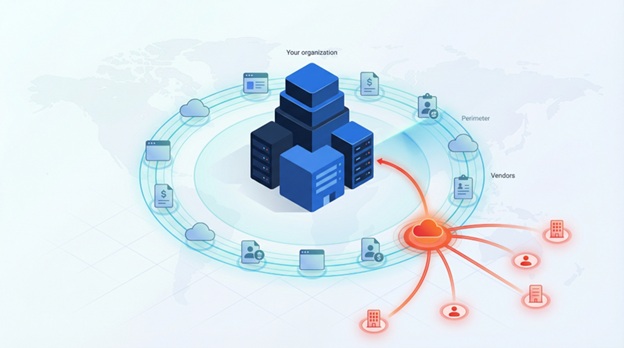
Your vendors now sit on your cyber perimeter. A single exploited payroll plug-in can become front-page news overnight.
In June 2024, the U.S. Justice Department told prosecutors to ask whether companies monitor third-party partners throughout the contract, not only at onboarding. That shift helped shape our review of six purpose-built platforms built for continuous oversight. In the sections ahead, you’ll see how each tool automates vendor monitoring, uses AI to cut analyst effort, and helps you keep up with fast-moving compliance expectations.
Why third-party cyber risk is spiking in 2026
Third-party incidents no longer stay contained. One exploited supplier can disrupt an entire customer base in days.
The MOVEit breach shows how quickly the blast radius can grow. By June 2024, investigators had already counted 2,773 organizations impacted by the Clop gang’s MOVEit file-transfer campaign, nearly triple early estimates, according to an Emsisoft analysis. Hospitals postponed chemotherapy, payroll platforms stalled, and airlines scrubbed flights while teams rushed to isolate vulnerable software.
The financial consequences rose in parallel. IBM’s 2024 Cost of a Data Breach report puts the average loss at USD 4.88 million, a 10 percent increase, and notes that one in five incidents starts with a third party. That is why insurers now ask for supplier inventories before quoting premiums, and boards press CISOs to explain which vendors carry the most risk.
Regulators also raised the bar. Europe’s Digital Operational Resilience Act (DORA) requires banks and fintechs to test key vendors year-round, and multiple U.S. state privacy laws demand proof that every processor protects personal data. Add the U.S. DOJ’s 2024 directive pushing life-of-contract oversight, and the takeaway is straightforward: a one-time questionnaire is not enough.
Attackers are accelerating, too. Microsoft threat-intelligence teams recently traced phishing kits that use large language models to generate persuasive lures at scale. In response, security teams are wiring AI into supplier monitoring so anomalies surface in minutes, not quarters.
Together, these shifts turned third-party cyber risk from a side issue into a primary attack surface for 2025. Next, we break down six platforms designed to help you monitor suppliers continuously without slowing the business.
How we chose the six platforms that made the cut
Selecting a third-party risk management (TPRM) platform should lead to a defensible shortlist, not another round of demos that all sound the same. We screened every candidate in four steps:
- Core focus. The product had to specialize in third-party cyber risk. General contract suites and pure consultancies did not qualify.
- Seven-factor scorecard. We scored each platform across seven criteria, weighted to reflect what most programs struggle to sustain after onboarding:
- Continuous monitoring (30 percent)
- Automation and AI depth (20 percent)
- Flexible risk scoring (15 percent)
- Compliance mapping (10 percent)
- Integrations (10 percent)
- Vendor collaboration (10 percent)
- Effortless scale (5 percent)
- Monitoring and automation earned the highest weight because only 23 percent of security leaders track vendors in real time today, according to Gartner.
- Independent evidence. We verified key claims using analyst notes, public road maps, and at least one reference customer, not marketing pages alone.
- Market traction. To advance, tools needed either 250-plus paying customers or a recent mention in a leading analyst guide.
The six platforms that made it through fall into three archetypes: integrated suites, external ratings engines, and specialized workflow or service models. Within each cluster, we flag one editor’s pick where data breadth, automation, or rollout speed stands out.
Integrated compliance + TPRM suites
Integrated suites are a strong fit when you want one place to answer two questions at once: “Can we prove we’re secure?” and “Can we trust our vendors?”
These platforms combine third-party risk management with the dashboards you already rely on for compliance evidence, privacy work, and audit trails. That consolidation cuts down on one-off spreadsheets, creates a single record auditors can follow, and keeps your vendor register live as your supplier list changes.
If your team is tired of running separate tools for audits and vendor oversight, start here.
Vanta
Vanta is best known for automating SOC 2, ISO 27001, and HIPAA, and it extends that same evidence-driven model into third-party risk management (TPRM). Teams that adopt Vanta’s TPRM platform report spending up to 50 percent less time on vendor security assessments. That productivity edge comes from AI-powered reviews and continuous monitoring that keep findings current between audits.
Buyer fit: Vanta is a strong match for mid-market and enterprise security and GRC teams that need to assess vendors continuously, keep audits moving, and do it without adding headcount.
Core approach: A hybrid model that combines inside-out assessments (intake, tiering, questionnaires, evidence collection, remediation tracking) with continuous monitoring, so vendor risk stays current after onboarding.
Capabilities summary: Vanta auto-tiers vendors, helps you run assessments, and turns findings into tasks your team can actually close. Questionnaires can arrive partially completed, and Vanta AI flags gaps, maps them to your policy, and drafts remediation tasks for you to approve.
Data sources & coverage: Vanta connects to 400-plus cloud, identity, and HR tools to pull evidence automatically. As of January 2026, Vanta also describes 400+ integrations and roughly 1,200–1,300 automated tests across common systems, which matters if you want monitoring and evidence collection to stay “always on,” not seasonal.
Continuous monitoring & alerts: Monitoring is designed to run throughout the vendor lifecycle. For example, when a new SaaS app is added through Okta, Vanta can assign an inherent-risk tier, schedule the right diligence, and notify your team in Slack if a vendor’s SOC 2 expires or a new CVE appears.
AI & automation: Beyond summarizing and flagging issues, Vanta positions AI as a time-saver. Customer-reported benchmarks cited in internal materials include up to 50 percent less time spent on security reviews and 62 percent faster evidence collection. For security questionnaires, Vanta also cites an answer-coverage rate of 80 percent+ and an answer-acceptance rate of up to 95 percent (results vary by program and question set).
Integrations & ecosystem: Vanta’s integration depth is one of its main differentiators. It’s designed to plug into the tools your teams already live in, then route work where it belongs, like pushing alerts to Slack and turning remediation into tracked tasks via ticketing workflows.
Governance & workflows: Vanta supports inherent-risk tiering, ongoing reviews, and remediation ownership, so vendor gaps are not just “noted,” they become assigned, time-bound work.
Reporting & stakeholder comms: For leadership and auditors, Vanta emphasizes a single source of truth, showing vendor status and evidence alongside audit readiness. Vendor-facing trust communications also play a role through Vanta’s Trust Center and Exchange.
Services / exchanges / evidence reuse: Vanta leans heavily on evidence reuse, including pulling information from Trust Centers and enabling vendor collaboration through Vanta Exchange, so you do less repeated document chasing.
Implementation & time-to-value: Vanta says teams can earn their first compliance report “in weeks instead of months,” and many programs can start ingesting vendor data quickly once integrations are connected.
Pricing & packaging: Pricing depends on modules and scope. Confirm packaging based on whether you’re buying VRM alone or pairing it with broader compliance automation.
Strengths
- Tight connection between VRM workflows and audit evidence, useful when the same team owns both
- Deep integration model for automated evidence collection and ongoing signals
- Strong automation story, with concrete “up to” time-savings metrics and questionnaire-acceptance benchmarks
Limitations & cautions
- Some advanced capabilities may be packaged as add-on modules, which can affect total cost
- Certain assessment-scoring and collaboration features may be delivered in phases; confirm current availability for your exact workflow
Ideal use cases: High-growth vendor environments, lean security teams under audit pressure, and programs that want vendor monitoring tied directly to compliance evidence and remediation.
Notable proof points: 400-plus integrations for automated evidence collection and 14,000-plus customers’ shared experience referenced by Vanta.
OneTrust
OneTrust is a long-time privacy leader that extends the same platform approach into third-party risk. If your organization already relies on OneTrust for privacy or data governance, its main advantage is consolidation: vendor risk, internal compliance obligations, and audit evidence can live in one place.
Buyer fit: Enterprises with complex, global privacy and security obligations that want third-party risk management tightly connected to privacy, compliance reporting, and governance workflows.
Core approach: Platform-led TPRM that combines questionnaires, scoring, remediation workflows, and an exchange model (Vendorpedia), with continuous monitoring signals layered onto vendor records.
Capabilities summary: OneTrust supports standardized and custom vendor assessments at scale. You can send a SIG Lite to a long tail of low-risk vendors, run deeper surveys for critical processors, and use automated scoring to flag gaps and push task lists back to suppliers without side-email threads.
Compliance mapping and content: OneTrust offers 50-plus ready-to-use frameworks, spanning requirements from GDPR to ISO 27001, and applies those mappings to third parties so you can manage first- and third-party compliance in a single view.
Data sources and evidence reuse: Vendorpedia is designed to shorten the start of the review. It launched with 6,000-plus security and privacy profiles ready to import, so if a supplier has already completed a common control set you can reuse responses instead of starting from zero. Validate current Vendorpedia coverage for your specific vendor population and industry.
Continuous monitoring and alerts: With continuous monitoring enabled, outside-in signals such as vulnerability scans, breach news, and sanctions hits flow into each vendor’s timeline. Alerts can route to tools like Slack or ServiceNow as soon as a risk signal changes, alongside mapped follow-ups.
AI and automation: Automation is strongest in campaign scale, scoring, and task routing. Internal review notes suggest teams should validate the current depth of AI for document review and the practical impact on analyst time for their use cases, especially if you are expecting advanced interpretation of SOC reports versus basic extraction.
Integrations and ecosystem: OneTrust is built for enterprise environments where procurement and security share ownership. Pre-built connectors can sync risk tiers into tools like SAP Ariba and pull renewal dates from Coupa, keeping vendor records aligned across teams.
Governance and workflows: Tiering, campaigns, automated reminders, and vendor follow-ups support repeatable lifecycle management. This is most valuable when you have multiple stakeholder approvals and want vendor remediation tracked inside the system of record.
Reporting and stakeholder communication: OneTrust is often used as a reporting hub for cross-functional stakeholders. Internal notes highlight embedded Power BI reporting, which can help large programs standardize dashboards and rollups across regions and business units.
Implementation and time-to-value: Time-to-value depends on how many modules and integrations you deploy. If you already run OneTrust, TPRM can slot into existing governance patterns. New deployments may require more upfront configuration to match your workflows.
Pricing and packaging: OneTrust is typically sold in enterprise packages, and internal pricing guidance suggests TPRM cost often scales with vendor count and user seats, with ranges cited from $40 k to $500 k plus potential services. Confirm current pricing and implementation scope with OneTrust for an accurate estimate.
Strengths
- Strong fit when privacy and third-party risk need to be managed together
- Large framework library and scalable assessment campaigns
- Vendorpedia can reduce repetitive due diligence when there is overlap with your suppliers
Limitations & cautions
- Continuous monitoring may be lighter than dedicated external ratings engines; confirm signal depth and update cadence
- Enterprise breadth can increase complexity; plan for configuration and services if you need tailored workflows
- Validate AI capabilities for the specific documents and control mappings you expect to automate
Ideal use cases: Global organizations consolidating privacy, compliance evidence, and vendor risk into one governance platform, especially when procurement integration and enterprise reporting are priorities.
Notable proof points: 50-plus frameworks; Vendorpedia launched with 6,000-plus profiles.
External security-ratings engines
When you need a near-real-time pulse on a supplier’s public attack surface, security-ratings engines are often the fastest place to start. These platforms scan the public internet, analyze large volumes of telemetry, and convert what they find into risk scores, often before you send a single questionnaire.
They’re most useful when your internal workflow is already solid but you lack continuous, outside-in visibility. In other words, they help you catch exposure and deterioration between formal assessment cycles, not just during onboarding.
SecurityScorecard
SecurityScorecard delivers outside-in security ratings, but packages them in a format executives can absorb instantly: an A-to-F grade. For vendor risk teams, that simplicity is the point. It gives you a common language to prioritize supplier outreach, set minimum thresholds, and show progress over time without turning every update into a technical deep dive.
Buyer fit: Teams that want broad, continuously updated vendor visibility and a collaboration model that encourages suppliers to fix what’s broken, not just answer questionnaires.
Core approach: Continuous external scanning across risk domains, converted into a letter grade and supporting findings you can share directly with vendors.
Capabilities summary: Scores refresh daily and roll up across multiple risk domains (such as DNS health, leaked credentials, and patching cadence). From a portfolio view, you can spot outliers quickly, then drill into the specific drivers behind a downgrade.
Data sources and coverage: SecurityScorecard says it continuously rates 12 million-plus organizations worldwide and owns 99 percent of its data-collection infrastructure. That scale matters if you need to baseline a large supplier set without waiting for self-reported information.
What the grade implies: SecurityScorecard states that companies with an F are 13.8 times more likely to suffer a breach than those with an A. Many teams use that kind of framing to support escalation, procurement gating, and board-level reporting.
Continuous monitoring and alerts: The platform is built for between-assessment awareness. When a score shifts, you can see which issue class changed and act before renewal time, not after.
Vendor collaboration: Collaboration is a core strength. Vendors can claim a free scorecard, review findings, and take remediation actions that update your view as improvements are made. Findings are designed to be actionable, with fix guidance that helps suppliers understand what to address.
Integrations and ecosystem: A well-documented API supports streaming grades and findings into GRC, SIEM, and procurement workflows, which helps turn “ratings” into trackable work instead of a static report.
Governance and workflows: SecurityScorecard is typically used as a triage layer. Programs use the grade to decide when to request deeper evidence, when to trigger contractual follow-ups, and when to escalate a supplier relationship based on objective thresholds.
Reporting and stakeholder communication: The A-to-F system is board-friendly by design. It also makes it easier to benchmark suppliers against each other and show whether remediation work is moving the needle.
AI and automation: SecurityScorecard offers automation in how findings are routed and worked with vendors. If you plan to rely on Atlas questionnaires and any prefill behavior, validate what it can populate from your data and prior assessments before treating it as a guaranteed time-saver.
Implementation and time-to-value: Typically fast, since most vendors will have an initial grade as soon as you add them to your portfolio.
Pricing and packaging: Enterprise, sales-led pricing, commonly driven by portfolio size and feature scope.
Strengths
- Executive-ready grading system that makes vendor posture easy to communicate
- Large-scale coverage and owned data-collection infrastructure
- Collaboration model that helps suppliers remediate issues and demonstrate improvement
Limitations & cautions
- Outside-in ratings do not replace inside-out diligence for critical vendors; you still need evidence, contracts, and targeted assessments
- As with any scanning-based approach, validate attribution and false-positive handling for key suppliers
- Confirm how questionnaire features (including Atlas) perform for your specific vendor set and workflows
Ideal use cases: Portfolio-wide monitoring, executive reporting, and vendor-engagement programs where a simple grade helps drive faster remediation.
Notable proof points: 12 million-plus organizations rated and 99 percent data-collection ownership, plus the 13.8× breach-likelihood claim tied to A vs. F grades.
UpGuard
UpGuard combines security ratings with lightweight questionnaire workflows, which makes it a practical option for lean teams that need vendor visibility fast but still want a way to collect and score vendor-provided details.
Buyer fit: Security and third-party risk teams that want quick outside-in baselining, straightforward workflows, and minimal rollout overhead.
Core approach: Outside-in scanning produces a vendor security rating you can use immediately, then questionnaires and reminders help you collect the additional context that scanning alone cannot provide.
Capabilities summary: Add a supplier domain and UpGuard generates a vendor profile that highlights issues like exposed data stores, expired TLS certificates, and leaked credentials, then translates that into a score. From the same workflow, you can launch a short questionnaire, automate follow-ups, and score responses against your policy.
Data sources and coverage: UpGuard reports that it monitors 10 million-plus organizations and updates scores every 24 hours. Expert notes also call out UpGuard’s 0-to-950 scoring model with A–F buckets, which is helpful if you want a simple threshold for procurement gating (confirm the latest model and definitions for your program).
Continuous monitoring and alerts: Alerts are designed to be readable and actionable. If credentials tied to a vendor appear in a dark-web dump, UpGuard can route the breach source, impacted accounts, and next-step guidance to Slack and open a Jira ticket for tracking.
AI and automation: UpGuard emphasizes automation through pre-populated ratings, reminders, and alert routing. If you’re expecting deeper AI support (for example, automated questionnaire completion or nuanced document interpretation), validate the current scope and accuracy for your use case before treating it as a core time-saver.
Integrations and ecosystem: Even with a lightweight UI, UpGuard’s API supports streaming ratings into a GRC tool or data lake, and operational integrations can push work into tools like Jira and Slack.
Governance and workflows: UpGuard fits best when you want a simple, repeatable loop: baseline a supplier, collect a targeted questionnaire for context, and convert findings into tracked remediation.
Reporting and stakeholder communication: Portfolio-level reporting is geared toward quick comparisons and trend tracking, which is useful for weekly risk reviews and executive updates.
Implementation and time-to-value: Because the database is pre-populated, many vendors have a baseline rating as soon as you add them. UpGuard positions this as a “days, not months” rollout, especially for teams starting from spreadsheets.
Pricing and packaging: Enterprise, sales-led pricing, typically based on portfolio size and features (ratings, assessments, integrations).
Strengths
- Fast initial visibility from pre-populated ratings and daily updates
- Practical, team-friendly alerting that routes into existing tools (Slack, Jira)
- Ratings and questionnaires in one platform, reducing tool sprawl for smaller teams
Limitations & cautions
- Outside-in findings can require validation for attribution and false positives, especially for critical vendors
- Less governance depth than full TPRM workflow engines; confirm fit if you need complex approvals or regulator-specific evidence mapping
- Validate AI capabilities and questionnaire-automation depth before relying on them to reduce analyst effort
Ideal use cases: Quick supplier baselining, continuous monitoring for exposure changes, and streamlined questionnaire workflows for teams that need coverage without a long implementation.
Notable proof points: 10 million-plus organizations monitored with 24-hour score updates; 1,000-plus customers cited in the original section.
Specialized workflow or service models
Big third-party risk programs rarely run in a straight line. When multiple business units are involved, approvals stack up, evidence gets routed across legal and procurement, and remediation can stall for reasons that have nothing to do with the control gap itself.
That friction shows up in outcomes. A Gartner survey found 45 percent of organizations experienced a third-party-related business interruption in the past two years, often because the process broke down in the handoffs.
Specialized workflow engines and service-backed models are built for that reality. They focus on configurable governance, approvals, remediation tracking, and in some cases expert review support, so the program keeps moving even when the org chart is complicated.
ProcessUnity
ProcessUnity is built for organizations that have outgrown templated vendor-risk workflows. If your program needs nuanced tiering logic, multi-step approvals, regulator-specific evidence, and remediation that stays tracked end to end, ProcessUnity is designed to adapt to your governance model instead of forcing you into someone else’s.
Buyer fit: Enterprise TPRM and GRC teams running complex, multi-stakeholder vendor programs, especially where consistency, auditability, and workflow control matter as much as the assessment content.
Core approach: A configurable workflow engine for third-party risk. You define how intake, tiering, scoring, approvals, and remediation should work, then automate the lifecycle so the register stays current.
Capabilities summary: ProcessUnity’s drag-and-drop designers let you tailor questionnaires, scoring formulas, approval gates, and remediation tasks without code. It supports dynamic tiering, so lower-risk vendors can move quickly while critical suppliers trigger deeper diligence, recurring reviews, and required uploads (like pen tests).
Data sources and coverage: ProcessUnity’s Global Risk Exchange is a key part of its scale story. It hosts 18,000 attested assessments and 370,000 automated risk profiles, and ProcessUnity says that covers roughly 80 percent of the Fortune 500. In practice, the benefit comes down to overlap; confirm how many of your critical suppliers participate before you count on Exchange reuse as a primary accelerator.
Continuous monitoring and alerts: ProcessUnity can ingest outside-in signals from providers like BitSight or SecurityScorecard, then update residual risk as new information arrives. That lets you move from “annual snapshot” to a living risk register where score changes trigger action.
AI and automation: ProcessUnity’s strength is automation through policy-driven workflow, not AI-first scoring. If AI-based document extraction or summarization is important to your program, validate what is available today and whether it meets your standards.
Integrations and ecosystem: Remediation stays operational because gaps become trackable work. Findings can sync into Jira or ServiceNow, and an open API supports pushing data into BI tools for portfolio trending and executive reporting.
Governance and workflows: This is where ProcessUnity stands out. It schedules campaigns, chases late responses, escalates overdue items, and keeps remediation tied to owners and deadlines. Teams use it to standardize how vendor-risk decisions are made across business units, not just how questionnaires are sent.
Reporting and stakeholder communication: Dashboards roll results into heat maps leaders can digest quickly. The goal is simple: make risk posture, bottlenecks, and remediation status visible without rebuilding reporting every quarter.
Services / exchanges / evidence reuse: The Exchange can reduce assessment workload when vendors have already completed attested assessments or profiles. Use it to speed onboarding and cut repeat requests, but treat it as a coverage multiplier, not a guarantee.
Implementation and time-to-value: Because the platform is highly configurable, implementation effort depends on how much of your governance model you want to encode up front. Many teams start with core intake and tiering, then expand workflows and integrations as the program matures.
Pricing and packaging: Enterprise, sales-led pricing, typically tied to scope (vendor volume, modules, and Exchange use).
Strengths
- Deep configurability for real-world governance and approvals
- Strong automation for campaigns, escalations, and remediation tracking
- Exchange scale can reduce vendor friction when there’s meaningful overlap
Limitations & cautions
- Configuration flexibility requires upfront design and change management
- Exchange value varies by industry and vendor participation; validate overlap early
- If you expect AI to do most of the analysis work, confirm current capabilities and roadmap
Ideal use cases: Large or federated organizations that need a configurable, auditable vendor-risk workflow engine and want to keep vendor reviews moving even when approvals and evidence requirements are complex.
Notable proof points: Global Risk Exchange scale—18,000-plus attested assessments and 370,000-plus profiles—with cited coverage across the Fortune 500.
Venminder
Venminder is built for a common reality in third-party risk: the bottleneck is not sending questionnaires, it’s reviewing what comes back—especially in regulated environments where auditors expect clear, documented conclusions. Venminder’s differentiator is its analyst-backed model, pairing lifecycle software with expert review services.
Buyer fit: Lean teams and heavily regulated organizations, especially financial services, that need help reviewing vendor documentation and producing regulator-ready write-ups without building a large in-house analyst bench.
Core approach: Third-party risk lifecycle software, plus an embedded services layer where Venminder analysts review vendor artifacts and return structured findings.
Capabilities summary: Venminder supports vendor inventory, inherent-risk tiering, tasking, and review cadences, then adds extra hands for the most time-consuming work. Upload a SOC 2 report, and Venminder experts review it, flag exceptions, and deliver a plain-language risk memo, typically within 48 hours. The memo lands next to the original document, which helps when leadership wants a decision-ready summary rather than raw reports.
Continuous monitoring and alerts: Venminder layers in breach intelligence, sanctions screening, and business-viability monitoring. If a vendor is hit by ransomware, shows up on a sanctions list, or suffers a credit downgrade, the platform can alert your team with recommended follow-ups, reducing manual news and monitoring work.
Governance and workflows: Playbooks map vendors to inherent-risk tiers, set review schedules, and trigger tasks. Dashboards track contracts, financial health, cyber findings, and SLAs in one place so vendor oversight does not get split across email threads and spreadsheets.
Reporting and stakeholder communication: Venminder is designed to produce documentation that stands up to scrutiny. The combination of stored artifacts plus review memos makes it easier to show regulators and executives both the underlying evidence and the reasoning behind your risk decisions.
AI and automation: Venminder’s value is primarily services-backed analysis and workflow automation, not outside-in ratings or AI-based scoring. If your program’s top requirement is real-time public attack-surface scoring across millions of vendors, you will likely pair Venminder with a ratings engine rather than expecting it to replace one.
Implementation and time-to-value: Time-to-value is often quickest when your team uses the analyst services to offload heavy document review early, while the software establishes a repeatable cadence for the rest of the lifecycle.
Pricing and packaging: Sales-led pricing, typically based on the platform scope plus the volume and type of analyst services required.
Strengths
- Analyst-written, plain-language memos that help teams make defensible decisions quickly
- Strong alignment to regulated workflows, including FFIEC-style expectations, while also supporting HIPAA and ISO evidence
- Monitoring signals (breach, sanctions, viability) that trigger actionable follow-ups instead of manual tracking
Limitations & cautions
- Not a dedicated external ratings engine; do not expect the same breadth of outside-in telemetry as ratings-only platforms
- Validate service SLAs and capacity for peak cycles (renewals, audits, large onboarding waves)
- Confirm integrations match your contract, procurement, and ticketing workflow if you need tight end-to-end automation
Ideal use cases: Teams under regulatory pressure that need consistent documentation and faster expert review of vendor artifacts, without hiring a large internal review team.
Notable proof points: Venminder cites 1,200-plus organizations using the platform, including hundreds of banks and credit unions.