
Next-Generation Localization Solutions for Apps and Interactive Games
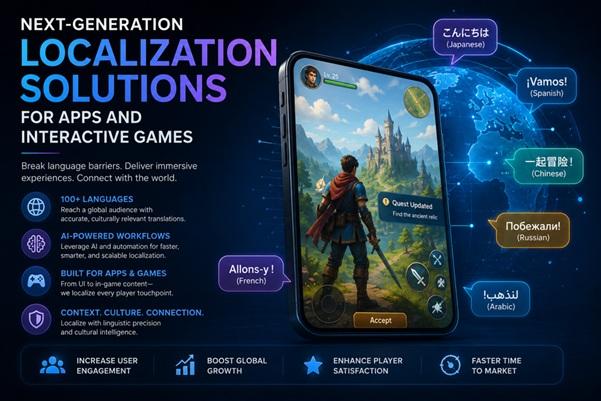
Most digital products don’t fail all at once. There’s no crash screen or clear warning that something went wrong. Instead, user interest quietly starts to fade. A user opens an app, pauses for a moment longer than expected, and then leaves without thinking much about it. Few teams trace that hesitation back to language, but in many real-world products, that’s exactly where the friction begins. This is where app localization services stop being a back-end task and start influencing how the product actually performs. It is no longer just about translating text. It shapes how naturally users move through the product. Teams often notice this only after launch, when the product is already live in multiple markets and the drop-offs are spread across different languages.
Why Localization Issues Don’t Show Up Clearly
One common misunderstanding in global product teams is assuming localization problems are caused by incorrect translation. In reality, most of the time the text is technically correct. The issue is how that wording fits into the overall user experience.
A sentence can be grammatically accurate and still feel unnatural in context. This often shows up in onboarding screens, tutorials, or first-time user flows. The wording may look perfectly acceptable on its own, but it doesn’t match the pace or intent of the interface around it.
A major reason for this is timing. In many teams, localization is added only after the interface design is finalized. At that point, language is forced into a structure it didn’t help shape. That creates small usability problems that appear again and again. This usually leads to a few recurring issues:
- Text that feels out of sync with interface the timing
- Tone that doesn’t fully match user expectations
- Microcopy that interrupts rather than guides
These issues can affect engagement and retention.
English as a Default and Its Hidden Limitations
English is used as the base language for global products. It appears neutral at first, but that neutrality can be misleading. Two assumptions are usually made:
- That all users fully understand the subtle meanings in English UI text
- That tone is interpreted the same way across regions.
In practice, neither assumption always holds. Many product teams notice a recurring pattern where users may understand the words but not the intended tone or intent behind interface language. This creates hesitation, especially in onboarding or decision-heavy flows.
This is also why localization principles from professional gaming translation services are being adopted in apps, platforms, and digital products beyond gaming. Games depend heavily on timing, feedback, and emotional clarity. Similar challenges appear in apps, dashboards, and digital platforms. When tone or pacing feels slightly off, users rarely report it; they simply stop engaging.
Japanese Interfaces and Structural Precision
Japanese localization requires more than direct translation. It usually involves rewriting content so that it fits how meaning is naturally structured in the language.
A common difference lies in instruction style:
- English interfaces use short and direct prompts.
- Japanese interfaces often use more contextual wording and a less direct tone.
If this shift is not handled properly, even correct translations can feel abrupt or unnatural. Reading structure is another important factor. Japanese users process interface text in grouped visual patterns. If spacing, hierarchy, or segmentation are not carefully adapted, the interface can feel harder to scan even if the translation itself is accurate. In practice, the challenge lies in how information is structured in the interface.
Arabic Interfaces and Flow Direction
Arabic introduces changes that go beyond a right-to-left layout. It changes how users navigate content. In real product environments, one issue appears repeatedly: simply mirroring the layout is not enough. Even when the interface is visually aligned, the experience can still feel unfamiliar. if the hierarchy is not redesigned properly.
Once the messaging was adjusted to feel more natural and less transactional, user engagement became more stable. The improvement came from changing how the system communicated with users.
European Markets and Different Expectations
Many companies still approach Europe as a single market. But in practice it behaves like multiple distinct user groups. Different regions respond to different styles:
- German users prefer clear structure and predictability.
- French users are more sensitive to phrasing quality and tone.
- Nordic users prioritize simplicity and minimal effort.
- Spanish variations can change meaning depending on the region.
Trying to unify all of this into a single tone strips personality from the product. Instead, effective localization gives teams room to adapt content by market. At this stage, localization becomes closer to product design than translation. It influences how releases are shaped for each market.
South Asian Usage Patterns and Short Attention Windows
South Asian markets highlight a different reality: very brief app sessions. Users open apps frequently but for very short periods. This creates a narrow window where clarity matters more than detail.
Another common pattern is mixed language usage. Users switch between English and local languages within the same session. This works smoothly only when the interface supports it naturally without forcing a fixed language structure. Where many products struggle is not translation quality, but information overload. Too much text, too many steps, and making users wait too long to see benefits reduces engagement quickly. In fast-moving mobile environments, the priority is the speed of understanding.
Real Example: Pokémon GO
Pokémon GO offers a clear example of how localization affects user behavior beyond translation. The core gameplay was the same across all regions, but early user behavior varied. In some markets, users quickly understood exploration prompts and navigation cues. In others, some users found the instructions less intuitive. The wording did not always match local expectations.
After localization teams adjusted phrasing and guidance structures to better match local expectations, users became more comfortable with the experience. Session time improved, even though the underlying code remained unchanged. This shows that small changes in communication design can directly affect engagement patterns.
What Many Teams Still Overlook
Three points often get missed in global product development: First, localization is not a one-time step before release. It continues after launch through feedback and iteration. This is one reason why businesses increasingly invest in professional app localization services rather than treating localization as a final checklist item. Second, it is not only a language task. It requires collaboration between design, development, and localization teams. Third, most users don't consciously evaluate translation quality. They judge whether the product feels easy to use.
Final Perspective
Localization is usually treated as something that happens at the end of the development process. However, it is closer to the user experience framework itself. It contributes to how the product is experienced, either as a seamless one or an off-putting one. Moreover, it affects if the product seems easy to use or difficult. Last but not least, it impacts the user engagement.