
3 Best Website Security Testing Tools & Vulnerability Scanners Compared for 2026
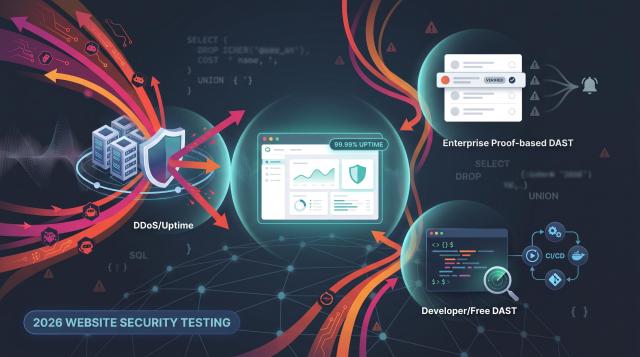
2026 has turned “busy” into “under siege.” Indusface's 2025 H1 AppSec report logged billions of AI-driven attacks on live sites and APIs in just six months.
According to SecurityWeek, one botnet hurled 11.5 Tbps at a single target before Cloudflare soaked it up—uptime now equals resilience.
Yet old wounds persist: MITRE’s 2025 CWE Top 25 still lists cross-site scripting at number one, with SQL injection and CSRF close behind.
We’ve hand-picked three complementary scanners to close those gaps—one to stress-test uptime, one to give every developer a free safety net, and one to scale verified detection across hundreds of assets. Ready to choose your weapon?
The 2026 website-testing market
Scroll today’s search results and you’ll find dozens of “top 10 scanners” that read more like vendor wish lists than buyer guides. Many mix free tools, enterprise suites and half-maintained open-source projects into one unranked blob. Useful? Hardly.
The market itself is even louder. Classic dynamic scanners now sit beside API-first testers, software-composition analyzers and full attack-surface platforms. Add specialist services that simulate DDoS storms or run human-led penetration sprints, and the catalog seems endless.
Choice is good until it paralyzes. Security leads tell us their real hurdle isn’t locating a tool; it’s choosing two or three that complement each other without burying teams in alerts or integration chores.
That insight set our filter. We skipped anything stale, single-purpose network scanners and tools with no credible user base in 2025–2026. Instead, we homed in on three standouts, each solving a clear, separate problem. Quality over quantity. Depth over checklist bingo.
Here’s how we judged them.
How we chose the final three
We set out to build a shortlist you can use, not another bloated leaderboard. We created a yardstick and measured every contender against it.
First came vulnerability coverage and accuracy. Ghost findings waste time. Independent tests from Autonoma show DAST false-positive rates stay high, and only a few tools verify exploits before alerting.
Second, technology fit. Modern apps sit inside JavaScript-heavy single-page shells and expose REST or GraphQL APIs. We favored engines that crawl with headless browsers, handle token authentication and refresh signatures the moment a new CVE appears.
Third, DevSecOps integration. If a tool can’t drop into GitHub Actions or Jenkins with one line, developers skip it. We looked for CLI helpers, Docker images and webhooks that push findings straight into Jira or Slack.
Next, ease of use. From first-scan setup to report clarity, smart defaults and a clean UI free security talent for tougher work.
Fifth, performance and scale. Enterprises run hundreds of sites and won’t wait a week for a crawl. Concurrency controls, smart scheduling and cloud delivery earned points.
Finally, cost versus value. Some tools cost thousands per app each year; others are free but demand sweat equity. We balanced price bands against feature depth using public figures compiled by Autonoma.
After those filters, three tools kept rising to the top, each strong on a different axis. They power the comparison that follows.
At a glance: three leaders, three missions
Need the snapshot first? The table below highlights each tool’s niche, delivery model, CI/CD fit and typical costs.
|
Tool |
Core focus |
Best for |
Delivery |
Stand-out capability |
CI/CD fit |
Pricing snapshot* |
Key drawback |
|
Red Button |
Live DDoS and infrastructure stress testing |
Enterprises that must prove uptime under extreme load |
Expert-led service |
Real botnet simulations up to 20 Gbps+ |
Not pipeline-oriented (report based) |
Project based, custom |
Scope limited to availability, not code flaws |
|
ZAP (by Checkmarx) |
Open-source DAST |
Dev teams on tight budgets or early in shift-left adoption |
On-prem or Docker |
Large plugin ecosystem, free forever |
Excellent (Docker image, GitHub Action) |
Free |
Needs tuning; moderate false positives |
|
Invicti (Acunetix) |
Enterprise DAST with proof-based verification |
Large orgs scanning dozens to hundreds of web and API assets |
SaaS or on-prem |
Auto-verifies exploitable findings to slash false positives |
Good (native plugins) |
About $15k–$30k per year |
Premium price; requires AppSec expertise |
*Prices are public estimates; final costs vary by asset count and contract length.
1. Red Button: survive a real DDoS barrage
Overview and key capabilities
Think of Red Button as a fire drill for your entire online estate. Instead of another dashboard light, it delivers a live, authorised DDoS attack, run by specialists, so you see exactly how the stack behaves under crippling load.
Red Button DDoS Testing and Vulnerability Assessment Service Screenshot
The engagement starts with a scoping call where engineers map critical paths, traffic thresholds and maintenance windows. The team then spins up a global botnet that can throw up to 20 Gbps of mixed-vector traffic across six to twelve scenarios, from UDP floods to HTTP/2 request storms.
During the exercise, you watch dashboards in real time while Red Button’s crew stays on the phone, ready to pause if anything crosses a safety line. When the packets stop, you receive a forensic report: resilience score, choke points, mitigation gaps and specific fixes. Those deliverables mirror the company’s own promise of a DDoS Resilience Score and full remediation roadmap inside its DDoS testing & vulnerability assessment service. A follow-up retest verifies improvements and turns theory into proof.
In short, Red Button’s DDoS testing and vulnerability assessment shows how you will handle an 11.5 Tbps-style assault before an attacker tries. That clarity is priceless for finance, gaming and SaaS platforms where minutes of downtime equal lost revenue or compliance risk.
Why Red Button stands out
Red Button tackles the question scanners ignore: will the site stay up when someone tries to knock it offline? Most DAST tools stop after listing code flaws. Red Button keeps going until every choke point in the network, WAF, CDN and incident playbook is battle-tested.
The human factor matters too. Seasoned DDoS engineers tune traffic mixes, monitor live impact and translate packet captures into fixes your ops team can ship the same day. The result feels more like hiring a sparring partner than buying a tool.
Upsides you’ll feel immediately
- Proof, not theory: a resilience score backed by real traffic patterns.
- Zero false positives: either the site stayed online or it didn’t.
- Vendor-agnostic insight: findings often reveal mis-tuned WAF rules or missing rate limits.
Trade-offs to plan for
- Scope is narrow — Red Button will not spot XSS or SQLi.
- Tests must be scheduled; spontaneous scans are not possible with live traffic.
- Pricing sits in the enterprise bracket, reflecting the expertise and risk.
If uptime equals revenue, Red Button delivers a unique confidence boost.
2. ZAP (by Checkmarx): free, battle-tested DAST for every developer
Overview and key capabilities
ZAP (formerly OWASP ZAP) is a versatile scanner you can download and run before your next coffee break. Born in the OWASP community and refined for more than a decade, it remains the most-installed dynamic scanner on the planet. Developers proxy their browser through ZAP, let it spider the site, then launch active probes that hunt the usual suspects: SQL injection, cross-site scripting, missing headers, weak TLS and a long tail of OWASP Top-10 issues.
ZAP by Checkmarx Web Security Scanner Interface Screenshot
The appeal starts with cost (free forever), yet the feature list hardly feels bargain-bin. A headless browser crawler covers multi-page apps, while an AJAX spider handles JavaScript-heavy flows. Import an OpenAPI spec and ZAP pivots into API-testing mode, fuzzing every endpoint it finds. Docker images and a maintained GitHub Action drop the scanner straight into CI, so every pull request can trigger a baseline scan without human clicks.
Extensibility is ZAP’s secret edge. Need GraphQL introspection, JWT brute forcing or custom passive rules? Install an add-on from the ZAP Marketplace or script your own in Python, JavaScript or Kotlin. The community releases plugins at a pace commercial vendors rarely match, turning ZAP into a living lab where new attack techniques surface first.
All that power comes with a learning curve, and we will cover tuning tips next, but as a zero-cost starting point no other scanner lowers the barrier to shift-left security quite like ZAP.
Why ZAP still leads in 2026
ZAP works because it delivers much more than its price suggests. Teams often install it as a sandbox and discover a scanner that rivals mid-market commercial suites in vulnerability coverage.
Community drives its momentum. Hundreds of volunteers push weekly updates, so signatures for the latest OWASP Top-10 issues appear within days, not months, after a new exploit trends on GitHub. That rapid cycle keeps ZAP effective as frameworks and attack surfaces evolve.
The tool also fits naturally into the developer toolkit. A single docker run drops ZAP into any pipeline, and the GitHub Action ships pass-fail gates that block merges when high-severity findings surface. Developers get feedback while code is fresh, turning security from a quarterly audit into a daily habit.
Finally, transparency breeds trust. Every rule, crawler tweak and false-positive fix lives in a public repo. If an alert looks odd, you can read the exact scanning script, fork it or file an issue—options closed-source vendors seldom provide.
Put together, ZAP’s zero-cost entry is almost beside the point. Its real value is a crowdsourced R&D lab that keeps even cash-strapped teams ahead of web attackers.
3. Invicti (Acunetix): enterprise scanning without the noise
Overview and key capabilities
Invicti makes one claim: if we flag it, it is real. Its Proof-Based Scanning engine safely exploits many findings, dropping a harmless file for SQL injection or reading a sample record for XXE, so security teams see almost zero false positives. Independent tests place Invicti in the “very low noise” column, a gift when you manage hundreds of apps.
Invicti Enterprise DAST Web Application Security Dashboard Screenshot
A headless-browser crawler walks React, Vue and Angular routes like a user, then shifts to REST, SOAP or GraphQL endpoints it discovers. Complex authentication is not a barrier; the scanner handles SAML, OAuth and multi-step login flows that block lighter tools.
When a scan ends, Invicti sends confirmed issues straight to Jira, Azure DevOps or ServiceNow, complete with steps to reproduce. Cloud and on-prem installs share one API, so you can run nightly SaaS scans while keeping sensitive intranet sites in a locked data center.
Cost targets enterprises, about $15k–$30k per year before volume deals, yet many teams recoup that spend in triage hours saved and audit pain avoided.
If your backlog is already crowded, Invicti buys time by cutting the noise and surfacing what matters.
What’s next: five trends shaping web-app testing in 2026
Shift-left is now the norm.
High-performing teams trigger automated scans in every pull request, not just nightly builds. ZAP’s Docker image and Invicti’s CI plugins make this easy, but the real shift is cultural: developers expect security feedback next to unit-test results, not in a weekly PDF.
APIs outnumber GUIs.
Microservices and GraphQL endpoints now dwarf front-end pages. Tools that import OpenAPI or schema files, then fuzz what they find, win the coverage race. Crawlers limited to HTML feel dated.
AI joins the scanning stack.
Vendors promote machine-learning payload generation and smart risk scoring. Early results help triage findings, yet human review remains vital. Treat AI as an accelerator, not a replacement.
Compliance spotlights availability.
The EU Cyber Resilience Act and PCI DSS 4.0 require proof of resilience. This focus on uptime is why DDoS simulations like Red Button’s move from “nice to have” to audit item.
False-positive fatigue sparks consolidation.
Teams drowning in alerts swap noisy scanners for proof-based platforms or layer IAST agents to trim noise. Actionable beats exhaustive every time.
These patterns explain why our three picks fit where the market is heading.
Conclusion
Picking a scanner in 2026 means balancing uptime assurance, developer-friendly workflows and signal-to-noise ratios. Red Button, ZAP and Invicti excel on those axes, helping teams stay resilient, shift security left and cut alert fatigue all at once.